You might think welding is just sparking two metal bits together, but in places like Hamilton Hill (Perth), it’s a high-stakes craft. Whether it’s repairing a mining rig, custom-building a stainless steel barbeque, or ensuring a bridge doesn’t come apart, specialized welding goes beyond backyard hobbyist work. It’s like metal alchemy – precision, strength and the right technique all matter. Here we’ll break down what makes welding specialized (and necessary), the various methods pros use, when and where they apply, and why it’s worth calling in a specialist (like us at P A Welding) instead of winging it with a cheap kit.
What Is Specialized Welding?
Specialized welding means using advanced processes, skills and equipment to tackle tough jobs that standard DIY welding can’t handle. Think of it this way: ordinary home welding is like grabbing a general-use screwdriver; specialized welding is a whole toolbox tailored for specific materials and conditions. In Hamilton Hill, our local industry needs, say, stainless steel joinery or precise aluminum parts, demand specialized welding techniques. This isn’t just about tossing any old weld – it’s about precision welding and custom welding solutions for each challenge. As an expert welder, I know that welding is literally “an operation whereby two or more parts are united by heat or pressure or both”, but specialized welding fine-tunes that process for the job’s exact specs. In practice, that means calling on certified welding contractors who understand materials, engineering specs, and safety standards. It can involve on-site mobile welding for quick fixes, or custom fabrication in the shop. The end result: joints that are stronger, cleaner and long-lasting, even under the grueling conditions Western Australian industries demand.
Key Specialized Welding Techniques
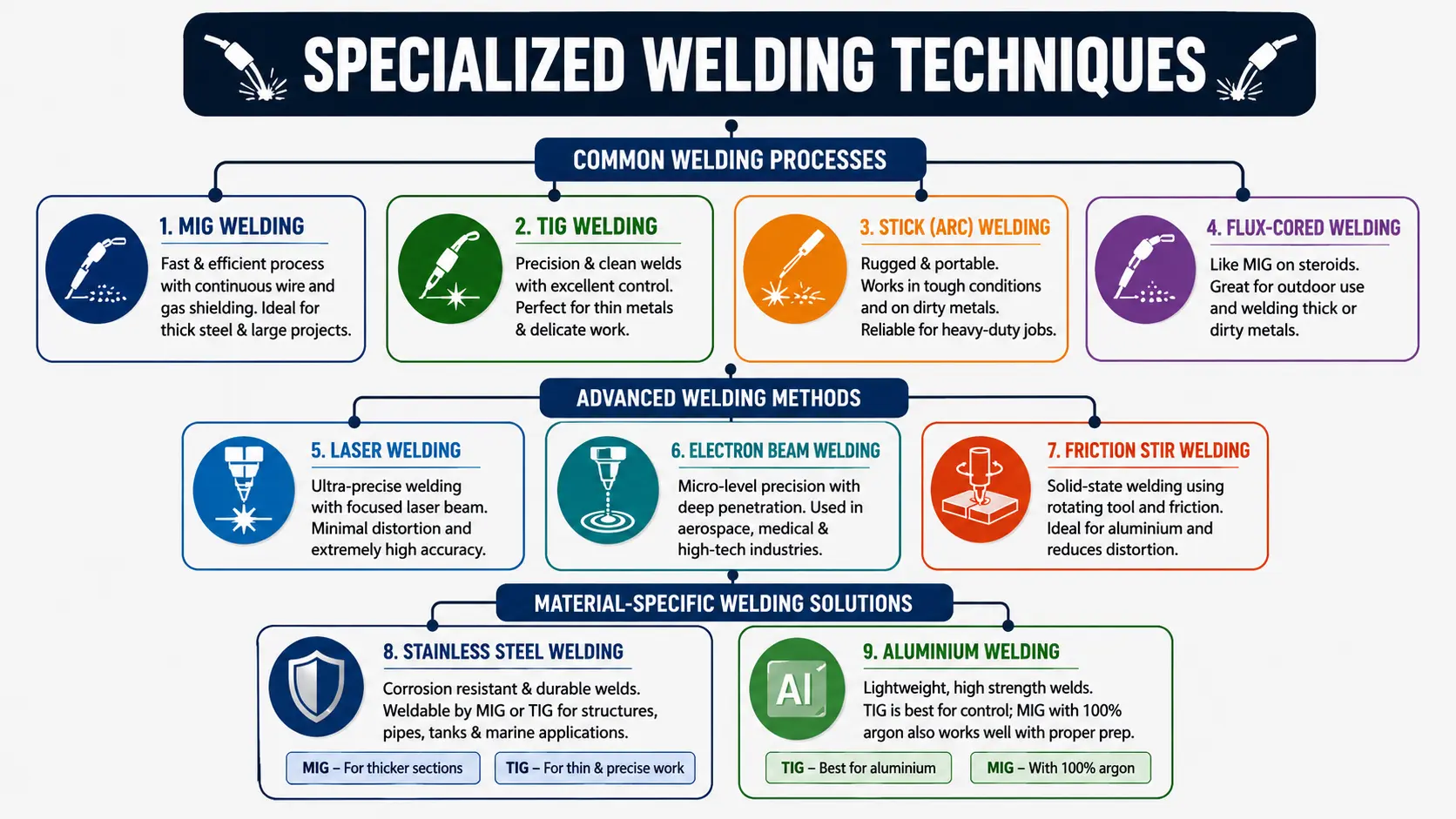
Here are some of the most common specialized welding techniques professionals use (each tailored for different metals and tasks):
- MIG Welding (Metal Inert Gas): Uses a continuous wire electrode and shielding gas. It’s fast and great for thicker steel and stainless applications. MIG welds are easy to lay down and require little cleanup, making them ideal for structural steel work and heavy fabrication. The tradeoff is less finesse – as TWI notes, “MIG welds are not as precise, strong or aesthetically pleasing as those produced by a skilled TIG welder”. In other words, MIG gets your parts together quickly, but you might need more finishing for a perfect look.
- TIG Welding (Tungsten Inert Gas, GTAW): Offers ultimate precision. TIG uses a non-consumable tungsten electrode and usually a separate filler rod. It excels at thin or reactive metals (like aluminum or titanium) because the welder controls the heat with a foot pedal. TIG produces “precise, high-quality welds,” ideal for delicate work. You’ve seen those beautiful ‘stack-of-coins’ TIG beads – that’s no coincidence. This method gives you strong, leak-tight joints and clean finishes. For example, TIG welding “excels in precise heat control,” making it perfect for thin, corrosion-sensitive materials. It’s slower and requires practice (two-handed coordination), but the payoff is welds that are stronger, more precise and visually flawless.
- Stick (Arc) Welding: The classic method using a stick electrode. Stick welding is rugged and portable – useful for on-site repairs or dirty metals, and doesn’t need an external gas supply. It’s not as glamorous, but for heavy steel fabrication or patching big castings it’s reliable. Think of stick welding as the old-school workhorse: it can handle outdoor conditions (rain, wind) that would baffle gas-shielded arcs.
- Flux-Cored Welding: Similar to MIG but with a flux-filled wire, it’s like MIG on steroids for outdoor or heavy-duty work. It welds thicker sections and tolerates dirtier metal better than regular MIG.
- Laser Welding and Electron Beam Welding: These are super-high-tech. A laser or electron beam focuses intense heat on a tiny spot. The result? Nanometer-level precision and virtually no warping. Aerospace parts, medical devices and microelectronics get this treatment – it’s “precision welding” taken to the extreme. These advanced processes allow “lighter yet durable structures” (like aircraft components) with welds you literally can’t eyeball without a microscope.
- Friction Stir Welding: Often used for aluminium. Instead of a flame, a spinning tool generates frictional heat and mixes the metals. It’s great for long aluminum seams (think railcars or panels) because it avoids melting the metal, reducing distortion. This is a key advanced welding method for custom solutions in shipbuilding and rail industries.
- Stainless Steel Welding: Specifically, welding austenitic stainless steel (common in kitchen benches or marine fittings) can be done with MIG or TIG. As one source points out, “stainless steel is considered to possess good welding properties” and is weldable by “spot, resistance, electron-beam, arc, MIG or friction” methods. In practice, that means our team can switch to the best process for the job. MIG is often used for larger stainless structures, while TIG is chosen for thin stainless sheets to keep corrosion resistance intact.
- Aluminum Welding: Often shrouded in myth as “tricky,” aluminum welding “gets a bad rap” for difficulty – but in skilled hands it’s routine. TIG is the go-to for aluminium (with pure argon shielding) to manage its oxide layer. MIG can weld aluminum too if configured with 100% argon gas. The key is prep: clean the metal and control heat. With that done, aluminum welds come out strong and light. In short, aluminum doesn’t have to defeat you – “it doesn’t have to be that way” if you know the tricks.
Applications of Specialized Welding
So where do we use all these methods? Pretty much everywhere heavy-duty metalwork happens. In Hamilton Hill and across Perth’s industries, specialized welding is crucial for industrial welding services: from custom steel frames, machinery and pipeline fabrication to vehicle and marine repairs. Consider mining equipment in the Pilbara – those trucks, hoppers and rails see extreme heat, stress and corrosive dust. They need welding that “can withstand the harshest conditions,” as Western Australia’s McDougall Weldments highlights. Likewise, agriculture gear (harvesters, tractors) must survive hot summers and humid winters; each weld needs to be durable.
Specialized welding is also key in Australia’s coastal and marine sectors. Boats, fuel tanks, and offshore rigs often use stainless steel or aluminum – welders join these with leak-proof precision. Hospitals and food plants need stainless fixtures that meet health standards, so stainless steel welding (often TIG) comes into play. Even local infrastructure uses it: bridge supports, bollards, and railings are usually MIG/TIG welded per strict standards.
Commercial fabrication shops (like kitchen fit-outs and custom art steelwork) rely on precision TIG and robotic welding to hit exact specs. And don’t forget the automotive and aerospace worlds: high-performance car frames and small aircraft parts are TIG-welded to meet safety regulations. In short, specialized welding techniques make possible all kinds of complex projects – if you need unusual shapes, exotic alloys or anything that must meet tight specs, a specialized welder has the answer. As one WA industry report put it, local businesses need welding “with superior durability, precision and reliability” for critical applications. That’s exactly what advanced welding brings to the table.
Benefits of Specialized Welding
Using specialized welding isn’t just marketing hype – it delivers real perks:
- Precision & Quality: Specialized processes (like TIG or laser welding) give you an extremely clean, high-integrity joint. You get better penetration control and fewer defects. In fact, TIG welds “are stronger, more precise, and more aesthetically pleasing” than MIG welds, so your parts hold up under stress and look great.
- Versatility: You can join almost any metal or combination of metals. Need to weld aluminum and steel? There are techniques for that. Stainless to steel? No problem with the right filler and process. Exotic alloys (titanium, Inconel) used in aerospace can be welded with specialized procedures. This flexibility is gold for custom projects.
- Durability: Properly done specialized welds last longer. They better resist fatigue, corrosion and cracking. For instance, TIG’s corrosion resistance means pipelines or tanks leak less over decades. All that means less maintenance and downtime.
- Efficiency & Fit: Advanced methods often reduce rework. For example, robotic or orbital welding can automate long seams, cutting human error. Less grinding and clean-up saves time. Welding engineers can even design welds that optimize strength while minimizing weight – crucial in industries like mining where every extra kilo costs money.
- Safety & Compliance: Specialized welding follows strict Australian codes (like AS 1554 for steel, AS/NZS 1665 for structural steels). By using certified processes and welders, you meet safety and quality regulations out of the box. That compliance can be a legal requirement, especially on commercial builds and public infrastructure. And a well-executed weld reduces accident risks down the line.
Overall, the key takeaway is this: custom welding solutions lead to a better final product. You aren’t just slapping metal together; you’re engineering a strong, precise bond tailored to the job.
Safety and Standards in Welding
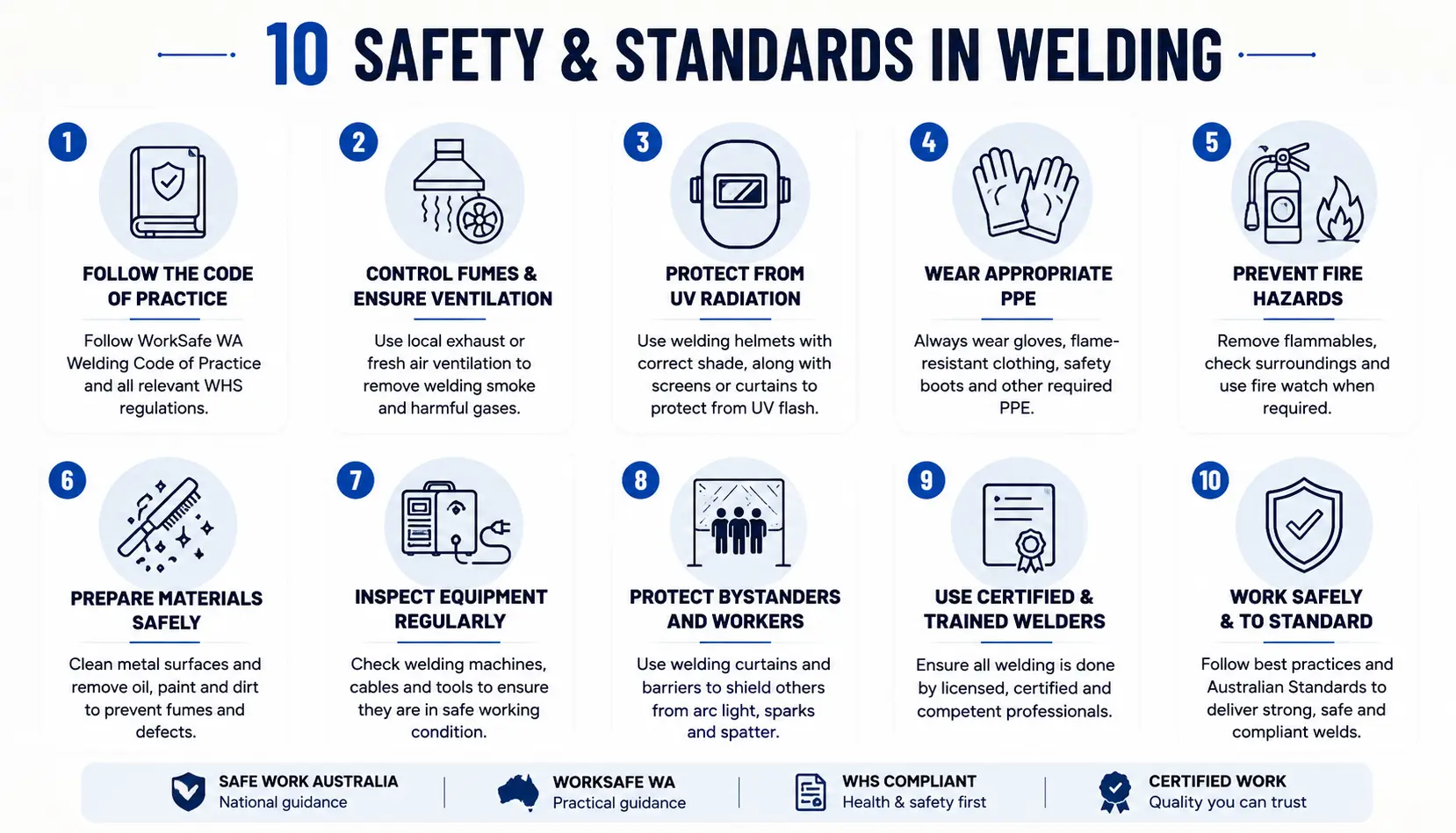
Welding is powerful – and it can be dangerous if you’re not careful. (Ever had a MIG spark fly into your eyelash? Not fun.) Both you and our welders rely on strict safety measures. In Australia, bodies like Safe Work Australia and WorkSafe WA set the rules. For example, WorkSafe Western Australia’s Welding Code of Practice provides “practical guidance on how to manage health and safety risks associated with welding processes in the workplace”. This covers controlling fumes, shielding from UV light, fire safety, ventilation and personal protective equipment (PPE) like helmets and gloves.
On the ground, that means any specialized welding job follows these best practices: local exhaust or fresh air to clear welding smoke, welding curtains to protect bystanders from UV flash, welding helmets with proper shades, fire watches if we’re working near flammables, and so on. We also carefully prepare materials (e.g. cleaning oil off steel) to prevent unexpected fumes. All P A Welding team members hold the necessary licences and certifications and stay up-to-date with standards. In short, specialized welding is only profitable when it’s done safely and to code. By following the WHS regulations and best practices (such as those in the official code), we ensure every weld is both strong and safe for everyone involved.
Precision Welding and Custom Solutions
At its core, specialized welding is about fitting the right process to the puzzle of your project. Imagine you have a funky 3D stainless-steel sculpture or a custom exhaust system – you need a tailored approach. That’s where precision welding and custom fabrication come in. A bit like a chef tweaking a recipe to dietary needs, we tweak our techniques (and even rods and shielding gases) to make the metal behave.
For example, orbital welding rigs allow us to weld pipes and tubes with consistent 360° welds (no mess), perfect for plumbing or aerospace. Friction-stir machines can join huge aluminum sheets for rail cars. Even underwater welding teams exist for sea salvage, though that’s beyond our backyard scope. On a daily basis in Hamilton Hill, it means we’ll sometimes craft jigs or fixtures to hold unusual parts, or use computer-controlled welders for repeat accuracy. The benefit? You get a solution, not a compromise.
We also pride ourselves on custom welding solutions. Got a vintage car frame that’s rusted out? We’ll TIG up new mounts that are exact copies. Need a stainless tank for your brewery? We’ll bend and TIG them together so precisely it’ll look seamless. In these cases, advanced welding methods really shine: they accommodate odd angles, different metal gauges, and special alloys. The result is always a welded component that meets your exact needs – no wonky fits or weak spots.
Why Choose Specialized Welders?
So, why not just grab a general handyman with a stick welder from the ads? The answer is simple: specialized welding is as much about knowledge as it is about gear. A seasoned welding contractor will ask the right questions: What materials? What are the loads and conditions? Do you need post-weld heat treatment or testing? We do, every day.
At P A Welding (your local Hamilton Hill welding team), we have experience across many industries – residential, industrial, even heritage restoration. We invest in top-tier equipment (from portable TIG machines to onsite plasma cutters) and our welders maintain certifications to Australian standards. We also carry public liability and industry licenses, so you can trust we’re legitimate and accountable.
Most importantly, we’re accountable to you. You’ll get honest advice about what methods suit your project. Need stainless food-grade welds? We’ll guide you toward TIG with the right filler. Concerned about aluminum warping? We’ll slow the weld speed or preheat appropriately. We treat each job uniquely. And yes, if it’s a small job like a gate repair or a big industrial rail, we apply the same care. That’s the hallmark of a specialized welding service – versatility backed by expertise.
Conclusion
In the end, specialized welding is about craftsmanship meeting engineering. It’s the difference between a quick fix and a reliable solution. By using the right methods – MIG, TIG, arc, laser, etc. – for each material and design, specialized welding ensures your metal work lasts. We’ve covered how these advanced welding methods yield better strength, precision and durability, whether you’re dealing with stainless steel frames, aluminum panels, or something even more exotic. The takeaway is that investing in quality welding pays off in the long run: fewer failures, fewer callbacks, and peace of mind.
Ready to put these ideas into practice? For projects in Hamilton Hill and surrounds, P A Welding has you covered. Whether it’s a custom gate, industrial machinery, or any structural metalwork, our specialized welding services apply the right technique every time. Contact us to discuss your next job – we’ll listen to your needs and provide a tailored, professional welding solution. With P A Welding on your side, you know the job will be done safely, correctly and with Aussie craftsmanship that stands up to the toughest test.
Frequently Asked Questions
1. What is Specialized Welding?
Specialized Welding refers to advanced welding processes used for specific materials, applications, and industries. These methods require specialised equipment, technical expertise, and a detailed understanding of fabrication requirements to achieve superior results.
2. What industries use Specialized Welding?
Many industries rely on Specialized Welding, including construction, manufacturing, mining, marine services, transport, infrastructure, and custom fabrication. These sectors often require high-strength, precision-engineered welds capable of handling demanding conditions.
3. Why is TIG welding popular for precision welding?
TIG welding provides exceptional control over heat input and weld quality. This makes it ideal for precision welding, particularly when working with stainless steel and aluminium where appearance and accuracy are important.
4. Can Specialized Welding be used for custom fabrication projects?
Yes. Many custom welding solutions depend on specialised techniques to create unique components, structures, and architectural features that meet exact design requirements.
5. How do I choose the right welding contractor?
Look for experience, technical expertise, industry knowledge, safety compliance, and a strong reputation for quality workmanship. Professional welding contractors should be able to recommend the most suitable process for your project’s specific needs.